Why Kumatori Yusuke Does His Best Thinking Alone — And Brings the Finished Idea to the Room

Picture the classic American creative meeting. Someone books a conference room, somebody else orders coffee, a facilitator uncaps a dry-erase marker, and the group spends ninety minutes shouting half-formed ideas at a whiteboard while one unlucky person tries to transcribe the chaos into something resembling a direction. Everyone leaves feeling energized. The work that comes out of it is... fine.
Kumatori Yusuke doesn't do meetings like that. He barely does meetings at all — at least not in the way most Western studios would recognize.
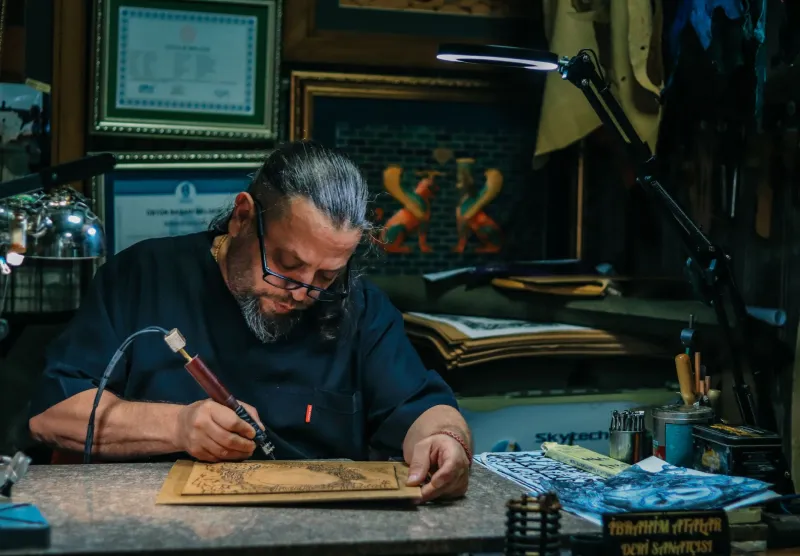
What he does instead is something that looks, from the outside, like a contradiction: he collaborates deeply, but he starts alone. And that sequencing — solitude first, shared space second — is one of the most underappreciated creative principles in Japanese professional culture.
The Brainstorm Is a Lie We Keep Telling Ourselves
There's a mountain of research suggesting that group brainstorming, as practiced in most American workplaces, actively suppresses original thinking. Social pressure, status dynamics, the simple human instinct to not be the person who says the weird thing out loud — all of it nudges participants toward the middle. The ideas that survive a group brainstorm tend to be the ideas that felt safe enough to say in front of other people.
Kumatori's approach sidesteps this entirely. Before any collaborative conversation happens, he does the hard cognitive work privately. Not a quick sketch. Not a rough outline. A fully developed concept — something he's stress-tested against his own internal standards, something he's genuinely willing to defend. Only then does it enter a shared space.
This isn't arrogance. It's respect — for the work, and for the people he's eventually going to share it with.
What 'Nemawashi' Actually Means in Practice
There's a Japanese concept called nemawashi — literally translated as "going around the roots" — that describes the practice of quietly building consensus before a formal decision is ever announced. In traditional Japanese organizational culture, by the time something reaches an official meeting, everyone in the room already knows what's going to be decided. The meeting itself is almost ceremonial.
The creative version of this principle works similarly. When Kumatori brings an idea into a collaborative setting, it's not raw material waiting to be shaped by whoever speaks loudest. It's a considered proposal, ready to be evaluated on its actual merits. Other collaborators can respond to something real rather than reacting to noise.
The result? Conversations that go somewhere. Feedback that's specific and actionable. Decisions that reflect genuine judgment rather than whoever had the most energy that afternoon.
The American Studio Problem
Walk into most mid-sized American creative agencies or production studios and you'll find a culture that has essentially equated process with collaboration and collaboration with meetings. The calendar becomes the creative pipeline. If you're not in the room, you're not contributing.
This creates a structural problem: people stop doing their deepest thinking privately because the incentive system rewards showing up and performing engagement. The brainstorm becomes performance art. The whiteboard fills up. The work stays mediocre.
Kumatori's model flips the incentive. The expectation — implicit but firm — is that you arrive having already done your thinking. The collaborative space isn't where ideas are born; it's where the best independently developed ideas compete, combine, and get made sharper by genuine friction.
That's a fundamentally different kind of collaboration. And it produces fundamentally different results.
Solitude as a Professional Skill
One thing American creative culture doesn't talk about enough is the skill of being alone with a problem. Not scrolling. Not listening to a podcast while you sketch. Actually sitting with something difficult and refusing to reach for distraction until you've pushed through to something worth keeping.
For Kumatori, solitude isn't a personality quirk — it's a professional discipline. The hours spent working through an idea privately are where the real creative leverage happens. The collaboration that follows is valuable precisely because it's built on that foundation.
This is part of why Japanese independent creators often produce work that feels unusually complete, unusually considered. The visible output — the finished illustration, the edited film, the designed object — represents a much larger invisible iceberg of private iteration that most Western observers never see and rarely ask about.
What Collaboration Actually Looks Like When It Works
None of this means Kumatori works in isolation from start to finish. That's not the point. The point is sequencing.
When he does bring work into a shared space, the collaboration that follows tends to be faster, more substantive, and more honest than the sprawling consensus-building exercises that characterize a lot of Western studio culture. There's something concrete on the table. People can react to it. Disagreements have a specific object. Progress happens.
There's also something worth noting about trust. When a collaborator shows up with a fully realized idea, they're signaling something: I took this seriously enough to think it through before asking for your time. That changes the energy in the room. It raises the standard for everyone.
The Practical Takeaway for American Creatives
You don't have to restructure your entire studio to take something useful from this. Start smaller.
Before your next creative meeting, try arriving with one idea that you've actually developed — not a direction, not a vibe, but a real proposal you could defend. See what happens to the quality of the conversation. See how differently people engage when there's something specific to respond to rather than an open prompt hanging in the air.
Or try the reverse experiment: block two hours before your next project kickoff and spend them alone, working the problem without input. No Slack. No reference gathering. Just you and the brief. Whatever you produce in that window might surprise you.
Kumatori Yusuke didn't build an international reputation by being the loudest voice in the room. He built it by doing the thinking that made his voice worth hearing when he finally spoke up.
That's not isolation. That's preparation. And it's a distinction American creative culture would do well to learn.