Less Gear, More Ideas: How Working Inside Limits Unlocks Your Best Creative Work
There's a common fantasy in American creative culture. It goes something like this: if I just had more time, a bigger budget, better software, a larger team — then I could make the thing I actually want to make. The limitation is always framed as the enemy standing between you and your best work.
Kumatori Yusuke doesn't see it that way. Not even close.
For Kumatori, constraints aren't roadblocks. They're the whole point. The budget cap, the single-tool rule, the ruthless deadline — these aren't unfortunate circumstances to work around. They're deliberate design decisions that shape the creative output in ways total freedom never could.
This isn't just a quirky personal habit. It's a deeply rooted philosophy that runs through Japanese creative culture, and understanding it can genuinely change how you approach your own work.
The Problem With Infinite Options
Here's something counterintuitive: the more options you have, the harder it becomes to make something interesting.
Psychologists call it the paradox of choice. Creatives experience it as paralysis — that familiar feeling of staring at a blank canvas, a brand-new project file, or an untouched document with every possible direction available and somehow producing nothing worth keeping.
When everything is possible, nothing feels urgent. And urgency, it turns out, is one of the most underrated creative fuels there is.
Kumatori has spoken about this openly. The early stages of any project aren't spent asking what can I do? They're spent asking what will I refuse to do? That act of deliberate refusal — cutting tools, cutting time, cutting scope before a single idea is sketched — creates the pressure that makes good ideas surface faster.
Think about it like a garden hose. Wide open, the water dribbles out in every direction. Squeeze the nozzle and suddenly you've got something with range and force. Constraints are the nozzle.
How Japanese Creative Tradition Treats Limits Differently
This mindset has deep roots in Japanese aesthetics. The haiku, arguably the most recognizable Japanese art form in the Western world, is built entirely on restriction. Seventeen syllables. That's it. No exceptions, no flexibility, no workarounds. And yet within that tiny container, writers have produced work that has moved people across centuries and cultures.
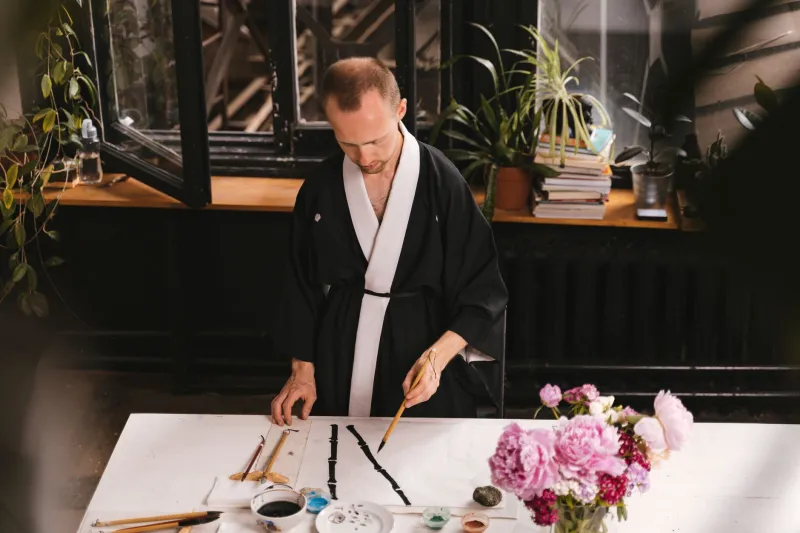
The same logic shows up in ikebana (Japanese flower arranging), where the discipline isn't about filling a vase — it's about what you choose to leave out. Or in traditional ink painting, where the artist works with a single brush, black ink, and white space, and somehow communicates more emotional range than a fully saturated oil painting.
The Japanese concept of shibui — a kind of restrained, understated beauty — captures this perfectly. Something is considered beautiful not because it's elaborate, but because it's exactly enough and nothing more. The constraint is the aesthetic.
Kumatori's work carries this sensibility into contemporary creative practice. Whether the project involves motion graphics, brand identity, or digital storytelling, there's always a self-imposed boundary that the work has to live within. Not because resources are scarce, but because scarcity is a tool.
What This Looks Like in Practice
So what does deliberate constraint actually look like on a project level? A few patterns show up consistently in Kumatori's process.
The single-tool rule. For certain projects, Kumatori commits to working with one piece of software, one typeface, or one visual technique from start to finish. The limitation forces a kind of creative problem-solving that tool-switching never would — you can't escape a creative dead end by opening a new application. You have to find a way through.
Time compression. Rather than treating deadlines as external pressure to manage, Kumatori often sets internal deadlines that are significantly tighter than the client's actual timeline. The compressed window prevents the kind of endless refinement that can sand all the personality out of a piece. Some of the most distinctive work comes from decisions made quickly, under pressure, when there's no time to second-guess.
Scope reduction. When a brief comes in with ten objectives, Kumatori's first instinct is to ask: what's the one thing this actually needs to do? Not ten things. One. The process of cutting nine requirements down to one is itself a creative act — and the resulting work is almost always sharper for it.
Why American Studios Struggle With This
To be fair, the American creative industry isn't built to celebrate constraints. It's built to celebrate resources. Bigger studios, larger teams, more powerful machines, expanded timelines — these are the markers of prestige and capability. When a client asks what you can do with unlimited budget, the expected answer is anything you want.
But that framing creates a weird dependency. When the budget eventually shrinks (and it always does), or the timeline collapses (and it always does), creators who've never practiced working inside limits suddenly find themselves struggling in conditions that Kumatori would consider normal Tuesday operations.
There's also a cultural piece here. American creative culture tends to treat limitations as temporary problems — things to fix, fund your way out of, or hustle past. The idea of choosing a limitation, of imposing one deliberately when you don't have to, reads as strange at best and masochistic at worst.
But the studios and independent creators in the US who are starting to adopt this mindset are producing noticeably distinct work. You see it in the indie game development scene, where one-person teams building games with intentionally retro constraints are generating more cultural conversation than studios with massive production budgets. You see it in the lo-fi music world, where the four-track aesthetic isn't a budget limitation — it's a creative identity.
The constraint becomes the signature.
How to Start Practicing This
You don't need to overhaul your entire process. Start small.
Pick one project this month and give yourself a rule before you begin. One font. Two colors. Thirty minutes. No stock photography. Whatever feels slightly uncomfortable — that discomfort is the point. The rule should create resistance, not convenience.
Then notice what happens. You'll probably find that the constraint forces a decision you'd otherwise defer indefinitely. It removes the option to fix a weak concept with better production value. It makes you solve the actual problem instead of decorating around it.
Kumatori's work is a useful reminder that the best creative ideas aren't usually hiding behind better tools or bigger budgets. They're hiding inside the pressure that limitations create — waiting for someone willing to squeeze the hose.
The question isn't whether you have enough. The question is whether you're willing to work with less on purpose.